
On this page
First check that every number describes the same serving
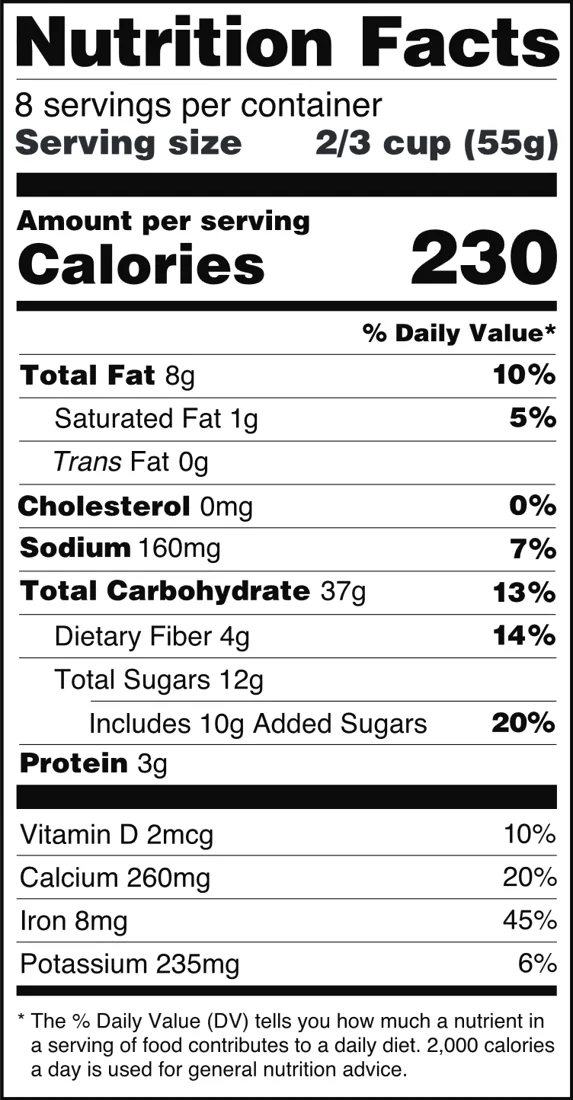
Before investigating why calories do not match macros, look at the serving information. A packet can show one column per serving and another per container. A food database may describe 100 g while your plate weighs 150 g. Multiplying the protein from one basis, the carbohydrate from another and the calories from a third cannot produce a meaningful comparison.
Write the basis beside each number: for example, “per 40 g serving.” Check the exact flavor and product variant, too. An app entry for a different version can look close enough to escape notice. The FDA’s serving-size explanation confirms that label nutrition usually refers to one declared serving and that serving size is not a recommendation for how much to eat.
This guide is for readers checking a package or a food calculator, not setting a calorie prescription. It explains the arithmetic, the limits of the shortcut and what to inspect when a difference remains. If you want the broader label-reading sequence, start with how to read a food label.
How to calculate calories from protein, carbohydrate and fat
The familiar estimate assigns 4 kcal to a gram of protein, 4 kcal to a gram of carbohydrate and 9 kcal to a gram of fat. “Macros” is shorthand for those macronutrients. A food Calorie, with a capital C, is a kilocalorie, abbreviated kcal. Use grams, not the percentage Daily Values printed elsewhere on a label.
Estimated macro energy = protein grams × 4 + carbohydrate grams × 4 + fat grams × 9.
In an illustrative example, 12 g protein, 18 g carbohydrate and 6 g fat give 48 + 72 + 54 = 174 kcal. These are teaching numbers, not a real product label. The calculation is useful as a check, but it is not the only method used to establish a food’s energy value.
The general factors and their limitations are described in the USDA’s Energy Value of Foods handbook. They estimate metabolizable energy: energy available after losses, rather than simply the heat a food could release when burned. That distinction is why a nutrition calculation needs a stated method.
Label rounding can make a correct calculation look inconsistent
Nutrition panels are rounded summaries. The number you can read is not necessarily the full value used behind the scenes. Protein, carbohydrate and fat are rounded under their own rules; calories are also rounded. Recalculating energy from the displayed grams therefore starts with less precise inputs than the manufacturer may have used.
The calorie rules in 21 CFR 101.9(c), in the published 2025 edition, specify 5-calorie increments up to and including 50 calories and 10-calorie increments above 50; amounts under 5 calories may be expressed as zero. The same provision says energy factors are applied to the actual food-component amounts before rounding. Those two operations need not reverse neatly.
Here is a constructed example using whole-gram rounding appropriate to these particular amounts. It illustrates the information loss; it is not a compliance assessment of an actual label.
| Component | Underlying amount | Displayed amount |
|---|---|---|
| Protein | 12.4 g | 12 g |
| Carbohydrate | 18.4 g | 18 g |
| Fat | 6.4 g | 6 g |
The underlying 4/4/9 calculation gives 180.8 kcal, which rounds to 180 calories. Repeating it with the displayed grams gives 174 kcal. Neither operation requires the missing 6 kcal to be “hidden” in a new ingredient. The two calculations simply use different precision. An isolated small discrepancy is a reason to inspect the method, not proof that a label is wrong.
Total carbohydrate includes fiber, but fiber is not all equivalent energy
On a US Nutrition Facts label, dietary fiber is included within total carbohydrate. Sugars are also part of total carbohydrate. You should not add the sugar grams to the total carbohydrate grams before using the formula. That counts part of the same material twice. Likewise, added sugars sit within total sugars, as our total-versus-added-sugar guide explains.
Giving every gram of total carbohydrate 4 kcal is a simplified model. Non-digestible carbohydrates are treated differently in some permitted energy calculations. The FDA’s dietary fiber fact sheet explains that fiber is not readily digested like other carbohydrate and that some fiber is broken down by bacteria and supplies energy. “All fiber has zero calories” is not a safe replacement rule.
This matters when comparing a high-fiber cereal or bar with a basic 4/4/9 result. The ingredient list can suggest why the shortcut needs care, but it does not supply every amount or processing detail needed to recreate a manufacturer’s calculation. Subtracting all fiber and then treating the result as an exact calorie correction overstates what the panel tells you.
Sugar alcohols and alcohol can also change the calculation
Sugar alcohols are ingredients such as xylitol, sorbitol and erythritol. Their name does not mean they are beverage alcohol, and they do not all have the same energy factor. The cited US regulation gives, for example, 2.4 kcal per gram for xylitol and zero for erythritol under its sugar-alcohol calculation method. It does not assign every sugar alcohol the carbohydrate shortcut of 4 kcal per gram.
A three-number macro check can therefore overestimate a food whose total carbohydrate includes substantial sugar alcohols. A “sugar-free” front-of-pack claim does not, by itself, tell you the product’s calories or which calculation applies. Read the whole panel and ingredient list rather than trying to repair the energy number from the claim.
Alcohol supplies energy too, and it is absent from the usual protein/carbohydrate/fat equation. The familiar shortcut is incomplete for an alcoholic food or drink unless that source of energy is accounted for. This guide concerns US food-label arithmetic; it does not assume that another jurisdiction uses identical carbohydrate definitions or labeling conventions.
A food database may use specific rather than general energy factors
Two energy estimates can differ even when nobody rounded a package label. General Atwater factors use the familiar average factors. Specific Atwater factors use factors appropriate to particular foods. The USDA Foundation Foods documentation distinguishes energy calculated using general factors from energy calculated using specific factors. It also explains that carbohydrate by difference includes dietary fiber.
That is relevant when one app recalculates energy from macro grams and another displays the database’s published energy field. They may be showing different estimates from the same record. Neither display should quietly pretend to be the other. Identify the food, its preparation, the record and the field used before comparing the results.
A database mismatch can be more ordinary, too: one record may describe dry oats and another cooked porridge. Preparation changes the amount of food represented by 100 g. Our raw-versus-cooked weight guide covers that separate problem. Changing an energy factor will not fix a weight entered against the wrong food state.
Why Plate Prism’s energy number and macro chart have different jobs
The nutrition calculator scales the published energy and nutrient values in its selected records to the weights you enter. Its calorie total is based on those energy values. The donut estimates the relative contributions from protein, carbohydrate and fat using 4/4/9. Its percentages describe that model, not percentages of a daily intake target.
The chart’s center and its slices therefore answer different questions. The center reports source-based calories. The slices explain the composition of the simplified macro-energy estimate. We do not overwrite a source’s energy field merely to make the illustration reconcile. Nor does a difference, by itself, establish which factor, rounding step or analytical method caused it.
You can inspect the connection with the weighed oats, yogurt and blueberry example. Change a weight and the estimates update. Missing nutrient values remain incomplete rather than becoming zero. It is an educational calculator, not a laboratory measurement of your bowl.
Why macro percentages need their own denominator
A macro chart introduces another calculation: the share of modeled energy supplied by each macronutrient. Return to the illustrative 12 g protein, 18 g carbohydrate and 6 g fat. Their modeled contributions are 48, 72 and 54 kcal, totaling 174 kcal. Dividing each contribution by 174 gives approximately 27.6% protein, 41.4% carbohydrate and 31.0% fat.
Those percentages describe the 4/4/9 estimate. If you instead divide those same contributions by a separate 180-calorie label total, the percentages add to about 96.7%, not 100%. That does not identify a fourth macronutrient. It shows that you have used one method for the numerator and a different total for the denominator. A chart should disclose which total it normalizes against.
Percentages by weight answer a different question again. A gram of fat and a gram of protein do not contribute equal energy in this model. You cannot draw an energy chart by dividing each macro’s grams by their combined gram weight and then call it a calorie split. Water and other food components also mean the sum of macro grams need not equal the serving weight.
When comparing apps, check both the numbers and what the picture claims to represent. The useful labels are specific: grams, modeled energy shares or source-based calories. An unlabeled percentage can conceal a denominator mismatch even when every individual number was copied correctly.
A practical order for checking a calorie discrepancy
- Put calories and all macro grams on the same serving or gram basis. Do not mix per-container values with per-serving values.
- Match the exact product and preparation. A similar name or a different flavor is not enough.
- Use total carbohydrate once. Do not add sugars or fiber to a carbohydrate number that already includes them.
- Check for rounding, non-digestible carbohydrate, sugar alcohols and other energy sources before expecting an exact 4/4/9 match.
- Look at the data source. An app entry may be user-entered, outdated or based on a different record.
If the discrepancy is substantial and persists after those checks, keep the original panel or source visible. Re-enter the numbers carefully and check the manufacturer’s published information where available. Do not change a food’s protein or fat grams just to force the equation to balance. That replaces an unexplained difference with information you know you invented.
There is no universal calorie-gap threshold in this guide that distinguishes a harmless rounding difference from an error. The appropriate interpretation depends on the serving size, ingredients and method. For a diet prescribed to manage a medical condition, ask the professional managing it which source and convention to use instead of applying a generic correction.
Common questions about calories and macros
Should I trust calories or macros when they do not add up?
Keep the source’s stated numbers together while you investigate the basis and method. A package’s calorie value and its rounded macro grams are not interchangeable measurements. This article does not choose an eating target for you. For two packages, the label comparison tool helps normalize the declared nutrient amounts, but it cannot establish the laboratory energy of either food.
Can a zero on a label mean a small amount?
Yes. Rounding and labeling thresholds can permit zero for sufficiently small amounts. The conditions differ by nutrient, so a printed zero does not establish that every molecule of that component is absent. Do not extend one nutrient’s zero threshold to every other row or use a rounded panel to establish allergy safety.
Does the difference mean the food contains extra sugar?
No. A failure to reproduce calories with 4/4/9 does not identify an ingredient or prove an amount of sugar. Total and added sugars have their own label rows. Read those rows and the ingredient list; use the discrepancy as a prompt to check the calculation rather than as evidence for a different claim.
The useful outcome is a consistent comparison: the same food, the same weight and a clearly named energy method. Once those agree, an unexplained small gap does not need an invented fix. If they do not agree, correcting the input usually matters more than another decimal place.
Sources and method
Source documents checked on October 26, 2026. Numerical rounding examples are explicitly constructed teaching examples, not manufacturer labels. The US regulation is linked in its 2025 published edition; the USDA documents explain methods rather than making claims about every current product. No independent clinical review is claimed.
- 21 CFR 101.9, published 2025 edition: calorie calculation, separate rounding and sugar-alcohol factors.
- USDA Agriculture Handbook 74: Energy Value of Foods: general and food-specific energy factors.
- USDA Foundation Foods documentation, April 2024: energy fields and carbohydrate by difference.
- FDA dietary fiber fact sheet: digestion and energy from different fiber types.
- FDA serving-size guide: matching the declared basis and distinguishing a serving from a recommendation.